How We Turned Customer Video Testimonials Into a Trust-Building Sales Tool
Why real customer experiences—and the way a website presents them—can matter more than another polished sales pitch.
Every company can say it sells reliable products and provides excellent service. A potential buyer knows that. When the purchase is expensive, the question becomes much more personal: Will this company deliver what it promises?
We faced that question while working on websites for two very different businesses: an agricultural equipment supplier and a concrete products manufacturer. Both needed customers to trust them before committing to substantial purchases. Instead of writing more claims about product quality, we decided to let existing customers talk about what had happened after they bought.
Start with genuine experiences
We called people who had already purchased equipment and asked if they would share their experience on camera. Participation was voluntary; we didn't offer discounts or payment. Most of the time, we traveled to the customer, conducted the conversation, and filmed the actual equipment as well.
The questions were simple: Why did you choose this supplier? What did you buy? How do you use it? What difference has it made? These prompts gave the interviews structure without turning them into scripted commercials.
Some interviews initially sounded too formal. We encouraged people to speak naturally, in their own words, rather than repeat marketing language. At one location, customers were in the middle of a celebration when we arrived. They still agreed to share their experience, and we captured footage of the equipment they owned. That scene stayed with us because it felt so ordinary—and therefore believable.
One farming customer described how a tractor and hay baler supported the family business, helped fund the children's education, and even allowed them to assist neighboring farms. Those were not benefits we could have invented in a product description. They were outcomes that mattered to the buyer.
Give the videos more than one place to work
We didn't hide the testimonials on an obscure page. The agricultural equipment site's homepage featured four recent stories and linked to a page containing the full collection. Videos were also available on YouTube, with links back to the business.
That produced two useful paths. Website visitors could discover real customer experiences while comparing suppliers. People exploring relevant content on YouTube could encounter a story first and then visit the store. Some buyers later told the business directly that they had discovered it through YouTube or that the videos helped them feel comfortable choosing it.
We also saw the value of filming ordinary business activity: equipment being unloaded, delivered, or used on a real farm. Those clips weren't replacements for testimonials; they added visible evidence that the company was active and knew its products.
A familiar idea, two different winners
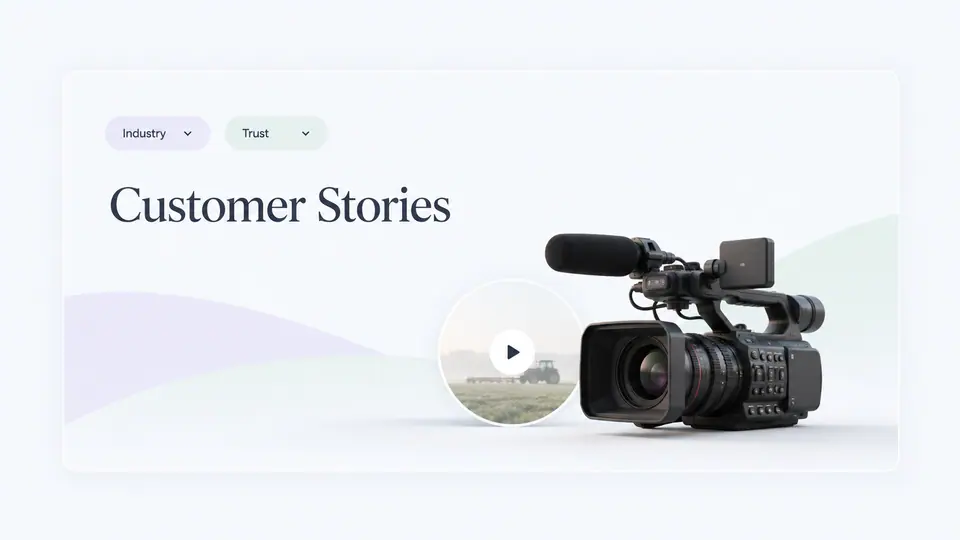
Once we had experience producing testimonials, we began testing their presentation. We compared conventional rectangular YouTube-style previews with circular, Instagram Stories-inspired previews accompanied by a short takeaway from the interview. The variants ran during the same test periods for different visitors, and we reviewed engagement and inquiries we could connect with testimonials.
On the agricultural equipment site, the circular story-like format performed better. On the concrete products site, conventional video thumbnails worked better.
Why? We had theories about audience expectations, but the experiment didn't establish the cause. It established that the same successful design should not be copied blindly between industries.

On the concrete website, we ran a second test: adding just two lines of descriptive copy to an otherwise simple video-preview block. Engagement and the associated inquiry results got worse rather than better. We removed the extra copy and kept a clear headline with a recognizable thumbnail.
Two lines of text seemed harmless. For that audience, the cleaner presentation was more effective.

What buyers told us
Some customers volunteered that the testimonials had influenced their decision. Others said they had compared competitors and selected our clients because the websites felt professional, worked smoothly, and provided convincing customer experiences—even when another supplier's price was lower.
We cannot responsibly assign an exact conversion-lift percentage to the videos years later. But we did have direct customer feedback, website observations, and controlled design comparisons. Those signals were enough to guide useful decisions.
The bigger lesson
The work was not simply video production. It was the combination of interview planning, authentic content, YouTube distribution, custom website components, and testing what encouraged a real visitor to engage.
A testimonial is not valuable merely because it exists. It becomes valuable when it answers a buyer's uncertainty, appears at the right moment, and feels genuinely credible. That is the difference between decorating a website with videos and designing a website that helps people make decisions.
Good digital experiences don't ask visitors to trust a claim. They help visitors find reasons to trust the business behind it.