When Marketing Outgrew the Factory: A Demand-Generation Case Study
We were hired to improve advertising. The unexpected lesson was that growing demand has to be matched by the business that fulfills it.
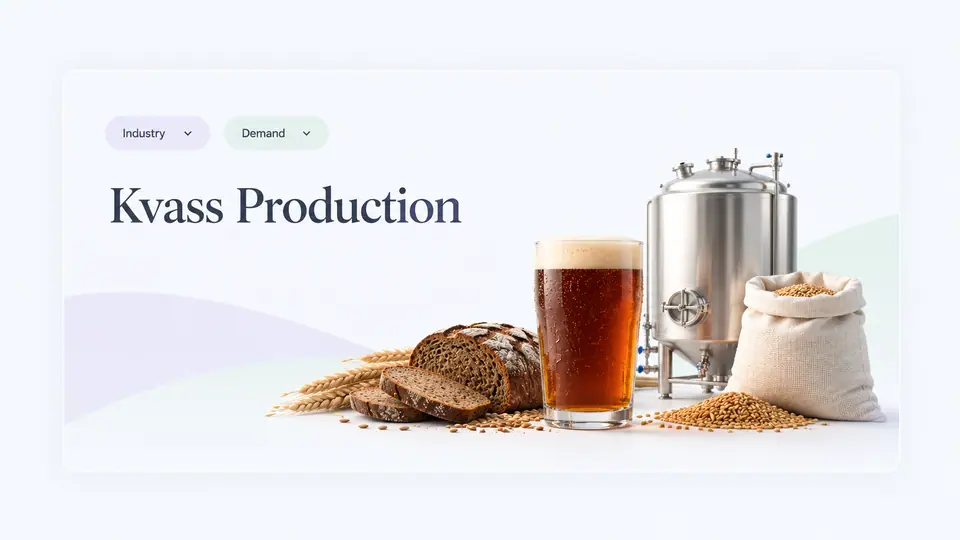
One of our most memorable projects involved a supplier of ingredients and raw materials used in the food and beverage industry, including products for making kvass. The company already spent money on advertising, including expensive animated placements on third-party websites. Its search advertising also existed, but the keyword coverage was narrow and the campaigns left considerable room for improvement.
The original request was to expand those display placements. After reviewing the situation, we suggested redirecting the effort toward a more carefully developed contextual search strategy instead.
A new way to reach buyers
We rebuilt the existing search campaigns rather than simply adding to them. We studied what potential buyers might search for, broadened the terminology, and gradually refined the targeting and messages based on incoming results.
The search landscape included professional food-production language as well as adjacent consumer-oriented topics such as kvass recipes and okroshka. Some broad topics brought irrelevant traffic, but they also occasionally uncovered surprisingly valuable business buyers. We kept useful segments when the orders justified the cost, instead of excluding every imperfect-looking query automatically.
Over time, the strategy focused more heavily on wholesale purchasers. Larger clients could order in substantial volumes and were more valuable over the duration of the relationship, while requiring less handling than an equivalent number of tiny retail transactions.
One inquiry even came from a remote northern location where transporting material required a transfer involving a helicopter. It was an unforgettable illustration of how far beyond the expected geography the advertising had reached.
Three months later, the warehouse was running empty
The speed of the response surprised us and the client. Around three months after the main campaign launched, inventory had been depleted to the point that the operation couldn't comfortably satisfy the demand arriving.
Before this, the production facility had operated on a single shift. As pressure mounted and existing commitments had to be fulfilled, the company moved toward three shifts, hired additional employees, and operated equipment around the clock. Maintenance staff needed to be available to address failures quickly because downtime had become extremely expensive.
Within roughly four months, the owner reorganized the available premises: moving certain operations and office functions to other company properties, freeing space for manufacturing, and expanding capacity. We did not manage that reorganization. Our work was advertising; the production decisions belonged to the people who understood and operated the factory.

The most useful marketing move was to slow down
When the owner told us the stock was gone, we reviewed what the campaigns were doing. Continuing to spend heavily to generate immediate orders the plant could not deliver wouldn't have been good for the business.
We stopped the high-volume campaign with the owner's agreement. We did not shut off demand entirely. Selected lower-intensity campaigns continued to collect future orders, and the company adjusted stated lead times so prospective buyers understood when deliveries could happen.
That distinction was crucial. The goal shifted from creating as much demand as possible to managing the kind of demand the company could responsibly accept.
Not every customer welcomed a longer wait. But the company was able to organize its obligations, add shifts, expand production space, and work through a substantial order pipeline.

A long period of unusually high activity
The accumulated orders and continuing lower-volume campaigns kept the operation busy for approximately a year and a half. The original high-volume campaign remained largely paused during that period. Only after the production and order situation stabilized could the company return to fuller advertising activity.
It's tempting to describe this story as a marketing campaign that 'broke the factory.' That would miss the more useful lesson. The factory already had real constraints, and the organization had to make difficult operational changes when demand increased. Our campaign was one catalyst; the expansion itself was accomplished by the owner's production team.
What this taught us
Sometimes marketing underperforms because targeting is weak. Sometimes it works so well that the business discovers its next bottleneck.
A useful growth strategy needs feedback from sales, inventory, production, and fulfillment. The right decision may be to increase the budget. But it may also be to narrow the audience, adjust delivery promises, or hold demand at a manageable pace.
Great marketing doesn't mean the largest possible number of leads. It means the right demand at the right time for the business that has to deliver.