We Didn't Just Advertise the Product. We Advertised What People Were Searching For.
A historical case study in search intent, pre-generated landing pages, and gradual improvement—with clear limits on product claims and attribution.
A product catalog tells visitors what a company sells. It does not always explain why someone who has never heard of that product should arrive in the first place. On one project, that gap became the starting point for a different approach to search marketing.
The company sold household ozone generators alongside other products. We gradually moved from a conventional catalog toward a system of focused landing pages, human-written content, reusable ordering components, and search campaigns built around what prospective customers were already researching. The change was cumulative. No single headline, interface, or campaign transformed the business overnight.
Over approximately 9–12 months, unit sales of household ozone generators grew roughly fivefold as the company progressively improved its website, search marketing, landing pages, and conversion process. This is an approximate historical estimate based on the company's sales data, not an independently audited result. It refers to units of that product category, not total company revenue or sales of unrelated products.
Search interest is not evidence of product effectiveness
This case study describes a historical marketing strategy. It does not establish that household ozone generators safely or effectively address the topics people searched for. Historical interests included refrigerator odors, vehicle interior smells, household odors, and questions about vegetables, fruit, meat, and food handling. Those are search topics, not verified product capabilities.
Current U.S. EPA guidance on ozone generators sold as air cleaners explains that ozone can harm health and that concentrations within public-health limits are generally ineffective at controlling indoor air pollution. We do not present this project as evidence of safe food treatment, pathogen removal, disinfection, or health benefits. A modern campaign would need substantiated, legally permitted claims appropriate to the actual product and use.
That distinction also improves the marketing lesson. A search can reveal a person's question without establishing that the advertised product is the right answer. Relevance is a starting point for responsible content, not a license to promise an outcome the evidence does not support.
From a catalog to a relevant first conversation
Initially, the website presented multiple products in a familiar catalog structure. We began by separating products into more focused landing pages. That made each offer easier to explain without asking visitors to sort through the whole range.
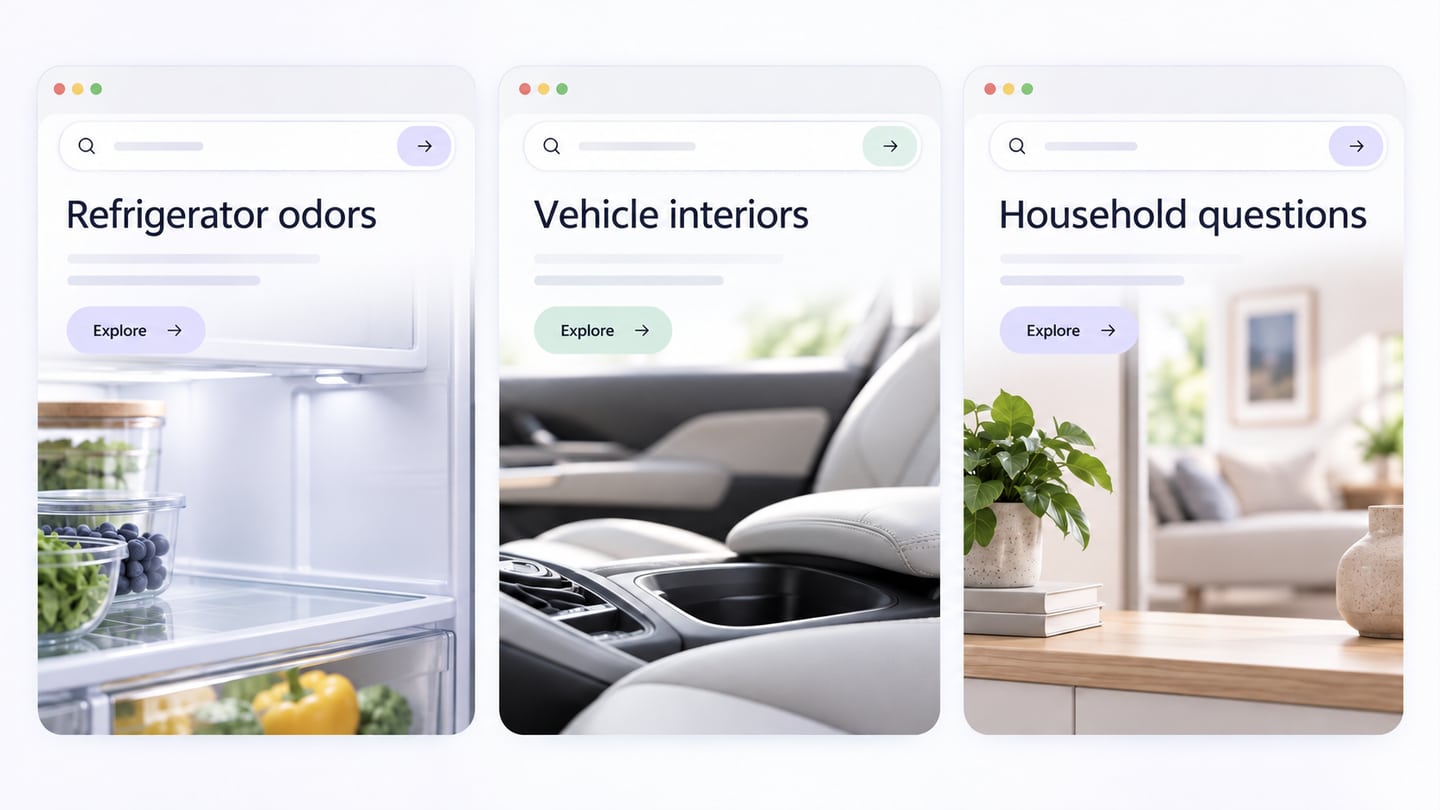
The next step was more specific. Instead of giving every visitor the same product page, we developed presentations around different search intentions. Someone researching refrigerator odors could encounter a page with a relevant heading, refrigerator-related imagery, and editorial material addressing that subject. Someone researching vehicle interior odors would see a different context.
The underlying product and some functional components stayed the same. The surrounding content changed substantially. This was not a different product for every keyword. It was a different starting point for the conversation, shaped around the question that had brought the visitor to the site.
That is also why search-context personalization needs more than a substituted headline. A meaningful landing page connects its imagery, explanations, structure, and next step. When only the keyword changes, the promise of relevance often disappears as soon as someone starts reading.
Hypotheses came before automation
Our team began with hypotheses about potential customer interests. We then checked those ideas against search demand, keyword statistics, audience behavior, competition, and commercial relevance. The software did not discover a universally successful strategy on its own.
The working sequence was straightforward: hypothesis, search demand analysis, relevant content, traffic, lead measurement, and optimization. Each step could change the next decision. An apparently promising topic might attract little demand, bring unsuitable inquiries, or prove too expensive to support through paid search.
We were looking for useful entry points that product-name advertising could miss. Someone already searching for the product is relatively close to that category. Someone searching for a problem may still be comparing possible approaches. Those audiences need different explanations, and neither should be treated as automatically ready to purchase.
Not every hypothesis became a successful campaign. The research process mattered because it gave us a way to test assumptions and stop supporting weak ones. It also kept the expanding page system connected to real audience questions rather than to the number of pages we could generate.
Approximately 60–70 themes, with more experimental versions
Over time, we developed approximately 60–70 distinct thematic landing pages. That is a historical estimate, not a precise audited inventory. Once experimental variations and A/B tests are included, the total number of generated page versions may have reached several hundred.
Those are different counts. A thematic page represented a distinct subject or search context. A variant might change a headline, subheadline, or presentation within that theme. Calling every variant a separate strategy would exaggerate the breadth of the system.
A page could have a relevant URL, context-specific headings, prepared illustrations, readable editorial content, ordering components, calls to action, and tracking for its forms. Human copywriters developed SEO-conscious material that people could actually read. Custom software assembled the appropriate components from that material.
The aim was not hundreds of low-quality keyword substitutions. Reusable structure made it practical to develop meaningful content across many themes. Editorial judgment still determined what belonged on a page and whether the topic offered a useful conversation with a potential customer.
Dynamic generation, static delivery
The generation system assembled content dynamically from reusable components and prepared material. The output was then generated in advance. Visitors received those prepared pages rather than asking the system to rebuild every page from scratch for each request.
Dynamic generation and static delivery served different purposes. Generation provided flexibility: a page could combine a particular topic, set of visuals, editorial sections, and ordering elements. Static delivery supported fast access to that result with less work at request time. We do not have a verified historical loading-time figure to attach to it.
Three ordering sections were reused across the website. Other elements changed with the theme. This separation helped maintain consistent functionality while leaving room for different editorial presentations. A shared ordering component did not have to be independently reinvented on every landing page.
It also made the system easier to maintain as it grew. A change to a shared component could be incorporated when pages were regenerated, while topic-specific writing remained distinct. That was a practical form of automation: reducing repetitive assembly work so that attention could stay on content, relevance, and measured results.

A compact information booklet instead of a wall of text
One part of the original website contained a long explanation of multiple possible use scenarios. It occupied substantial vertical space. Readers had to work through a large section even when only one topic interested them.
We reorganized that material into a compact JavaScript component resembling an illustrated digital booklet or category browser. Visitors could select categories and explore individual subjects. The interface made detailed material available without displaying everything at once.
A relevant initial section could be prepared directly in the page's HTML according to its topic. A visitor arriving through one search scenario therefore encountered the matching content immediately, while other sections remained available through interaction. The page did not depend on an initial click to establish its context.
Behavioral analysis suggested that interested visitors explored this component extensively. People who were not interested could scroll past a compact section rather than navigate a wall of text. There is no reliable engagement percentage to report, and the observation should not be mistaken for a controlled measurement of one feature's contribution to sales.
The enduring UX principle is simpler: make detailed information accessible without forcing every visitor to read everything. The reconstructed illustrations here show that organizational idea; they are conceptual interfaces, not recovered screenshots or endorsements of historical product claims.

Organic and paid search had different jobs
Search optimization and paid search both mattered, but we did not evaluate every page only through the economics of its advertising campaign. Content could remain useful for organic search even when purchasing traffic for the same topic was too expensive.
We tested campaigns and reviewed the price and relevance of the leads they produced. When a campaign brought reasonably priced, relevant inquiries, it could remain active. When acquisition costs were too high, we reduced its budget or paused it.
The underlying content page was not automatically removed with the campaign. It could still attract organic visitors. This separation allowed us to preserve useful editorial work without continuing to buy traffic on unfavorable terms.
Not every keyword needs to be profitable in paid search to provide value through organic search. That does not mean every topic deserves a page indefinitely. It means traffic sources have different costs, and their results should inform decisions instead of being collapsed into a single traffic total.
The same product, different acquisition costs
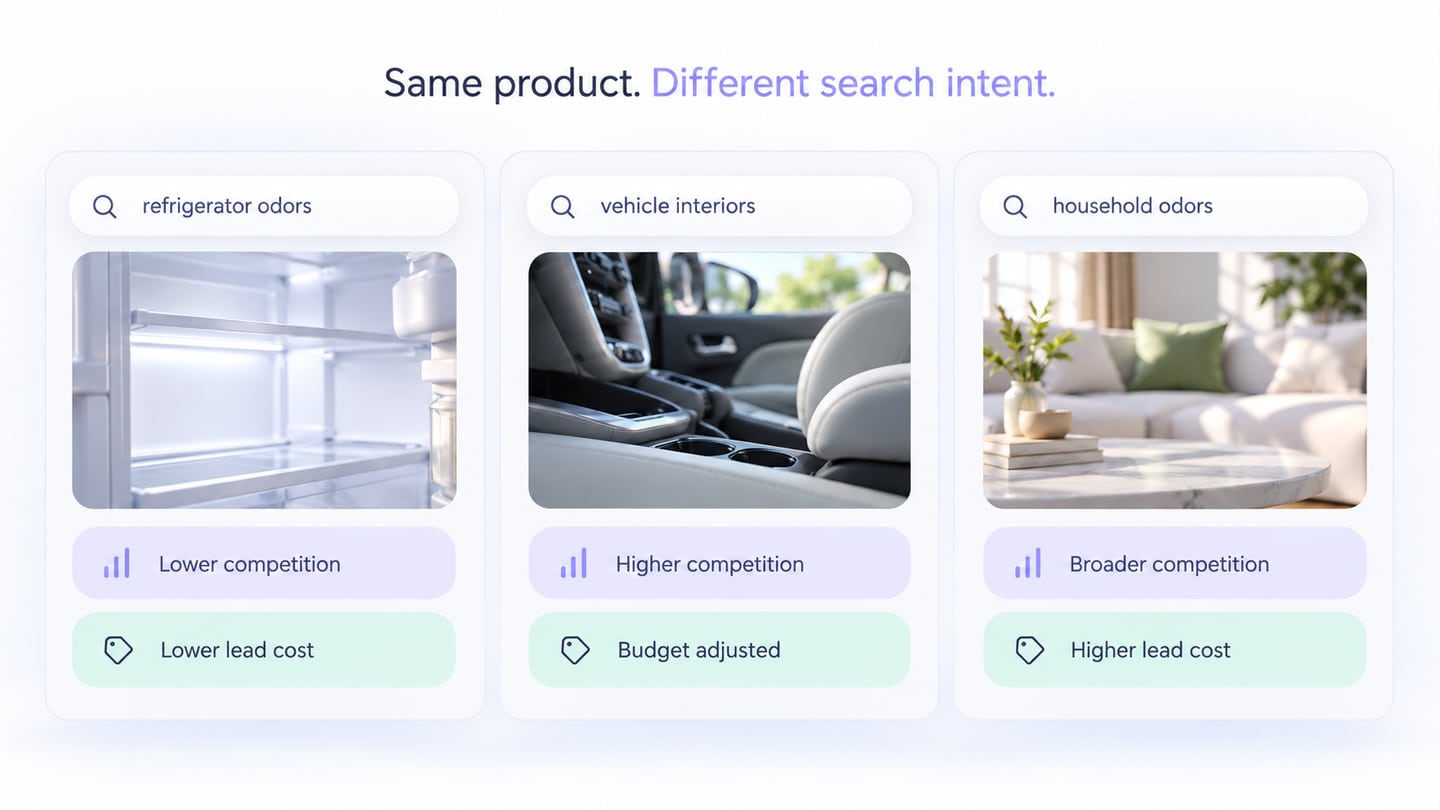
Refrigerator-related queries provided a useful example. Some faced relatively low advertising competition and generated inexpensive leads. Vehicle-related searches also produced relevant leads, but their advertising costs were higher. Some of those campaigns required budget reductions.
Broader apartment or household searches could be even more expensive. They brought the company into competition with professional cleaning businesses and other providers offering services with industrial equipment. That wider competitive landscape changed what it cost to reach the audience.
The product price stayed the same across these scenarios. The acquisition cost did not. A campaign could therefore bring plausible customers while still being a less attractive use of the available budget than another campaign.
We do not have verified historical CPC, cost-per-lead, conversion-rate, or return-on-ad-spend figures to publish. The lesson is the relative economics: more traffic was not automatically better. Budget allocation needed to reflect what the business paid for relevant opportunities, not simply how many people reached a page.
Track the inquiry without pretending it is a completed sale
Different landing pages contained multiple ordering or inquiry forms. The system recorded which page and which specific form generated an inquiry. That gave us a more useful view than one undifferentiated inbox or a single total of submissions.
A form submission usually did not complete a purchase. A company manager contacted the prospective customer and handled the final sale. Traffic, submissions, leads, lead quality, acquisition cost, and completed sales were related stages, but they were not interchangeable measures.
Landing-page tracking helped identify lead origins. Overall growth in completed product sales was measured separately using the company's sales data. We are not claiming that every completed sale was individually traced to a particular page, form, or advertisement. Nor are we attributing a modern end-to-end CRM workflow to a historical system that did not establish one.
That limitation does not make lead tracking unhelpful. It defines what the evidence can support. Understanding where inquiries came from improved campaign decisions, while the company's sales records provided a separate view of the broader commercial outcome.
Progress came from many ordinary improvements
We tested headlines, subheadlines, content presentation, and interface elements. There is no remembered extraordinary experiment that suddenly changed everything. The pattern was more methodical: develop a hypothesis, test a change, review the response, and continue improving.
The reported sales growth followed website modernization, product-focused pages, search-intent personalization, SEO work, paid search optimization, conversion-focused interfaces, A/B testing, better lead tracking, and custom automation. Those changes worked together over time. The historical record does not isolate the contribution of each one.
The owner recalls that the system remained in use for much of the company's subsequent lifetime. Its current operating status has not been independently confirmed. Longevity is part of the recollection, not a claim that the original implementation remains active today.
The strongest takeaway is a system, not a trick. Research identified relevant questions. Human writing turned those questions into useful material. Reusable components and pre-generation made the content practical to maintain and deliver. Measurement helped determine where to keep investing and where to pull back.
Don't just market what your product does. Understand what your customers are looking for, then make sure the information you offer is relevant and supportable. Growth does not always come from one breakthrough. Sometimes it is the result of dozens of improvements working together.