PHP Security Vulnerabilities: Why Infrastructure Control Matters
What CVE-2026-109618 and CVE-2026-109619 illustrate about hosting flexibility, security responsibility, and business continuity.

A hosting plan may seem like a minor technical decision until your business needs a server-level change and you discover that the decision is not yours to make. Most days, hosting stays in the background. Customers browse, forms arrive, and the website does its job. A security advisory can suddenly make the responsibilities behind that routine much more visible.
At NMR1, we chose a virtual private server before the October 2026 PHP security releases. Our reasons were practical: control over performance, flexibility in configuration, and an environment that could support custom websites and business applications. The security event did not create that decision. It illustrated why the decision mattered.
What the October PHP releases established
On October 21, 2026, the PHP project released security updates addressing CVE-2026-109618 and CVE-2026-109619. Its official advisory identifies both as critical vulnerabilities that can allow unauthenticated remote code execution. The project urged affected users to update and made clear that partial mitigations do not provide a complete solution. Those are the relevant public facts behind this story. Source: PHP's 2026 news archive and security advisory.
For a business owner, the useful distinction is between a problem in application code and a problem in the software that executes it. Reviewing a contact form or updating a website's content does not, by itself, replace an update to an affected PHP runtime. The response needs to reach the relevant software environment.
We are deliberately not reproducing exploit mechanics or publishing our server settings here. This article is about operational responsibility: knowing who can make a necessary change, being able to make it, and checking the result. It is not a claim that one hosting arrangement eliminates vulnerabilities.
Why we wanted control before the incident
A custom website often grows beyond its first brief. A straightforward brochure site may gain a quoting workflow, integrations, scheduled processing, or an application that supports daily operations. Infrastructure choices determine how readily the environment can accommodate that growth.
We wanted the ability to tune performance around the work our websites actually perform. We also wanted control over the software environment and security policies, rather than discovering that an essential setting was unavailable on a particular hosting plan. The goal was flexibility with a clear owner, not complexity for its own sake.
That approach complements our reasons for building a custom website engine. Choosing custom software makes sense when its advantages justify the maintenance responsibility. Choosing a VPS requires the same judgment. More access creates more options, but it also creates obligations that someone must consistently meet.
From advisory to verified operation
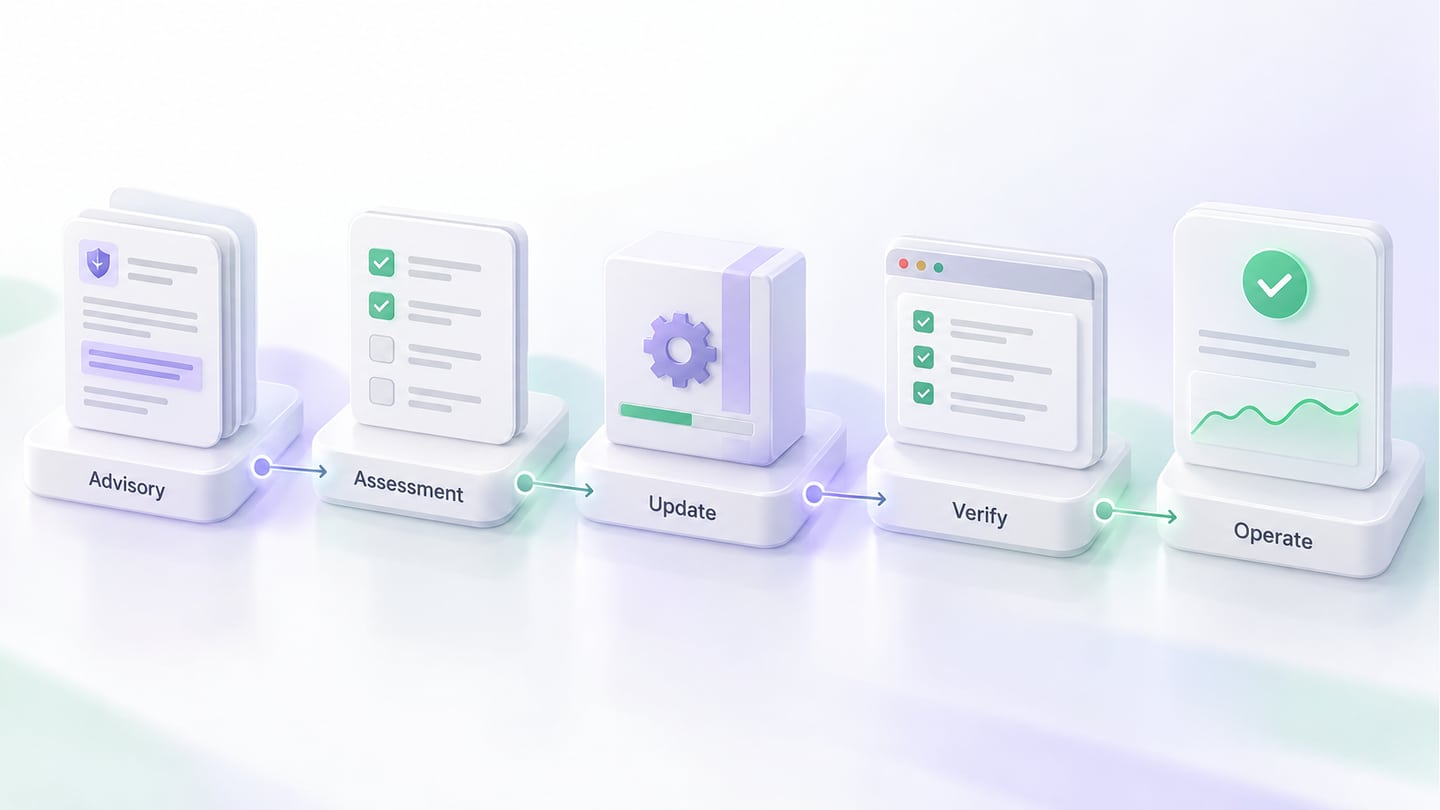
During the October incident, we reviewed the available security information, updated the affected PHP environments, applied appropriate security measures, and verified that the relevant services and websites continued working. That sequence sounds straightforward. Its value lies in completing all of it.
The advisory establishes what needs attention. Assessment connects that information to the environments the business actually depends on. The update addresses the affected software. Verification then checks that the technical change has not interrupted the services customers and staff use. Continued operation is the outcome the business needs, not merely a successful installation message.
The official updates were central to that response. Temporary measures that reduce a particular exposure are not an equivalent substitute for the fixes addressing these two CVEs. We are not combining a separate vulnerability or a separate mitigation into this account, and we are not suggesting that a workaround made an affected installation safe.
Control helped because we could act directly on the environment we administer. It did not make assessment unnecessary, remove the need for care, or guarantee that every future incident will be simple. The practical benefit was a shorter chain between understanding a required change and having the authority to carry it out.
Shared, managed, or VPS: match responsibility to the business
Shared hosting can be an excellent fit for many websites. A capable provider may handle updates, maintenance, and routine operations efficiently, leaving a small team free to focus on its business. The relevant question is what the service includes and how responsibilities are divided.
Depending on the plan, a shared-hosting customer may have limited access to server-level configuration. When a change falls outside those controls, the provider must implement it. That arrangement can work well when the provider communicates clearly and responds effectively. It becomes a limitation when a business needs a capability or response the plan does not supply.
A properly maintained VPS offers greater configuration flexibility and control over its software environment. It does not automatically offer better performance than every shared plan, and it is not automatically secure. An unattended VPS with broad permissions and delayed updates can create serious problems despite its owner's administrative access.
Managed hosting offers another way to allocate responsibility. A business can seek operational expertise while retaining the capabilities its application needs. The useful comparison is therefore not a simple contest between hosting labels. It is a comparison of access, support, maintenance ownership, workload requirements, and the ability to respond when something changes.
Before choosing, ask practical questions. Who installs runtime security updates? Who checks compatibility afterward? Who can change server settings? Who monitors failures? Who restores the service if an update or an unrelated incident causes trouble? Clear answers are more valuable than a plan name or an ambitious performance promise.
Security is a set of maintained practices
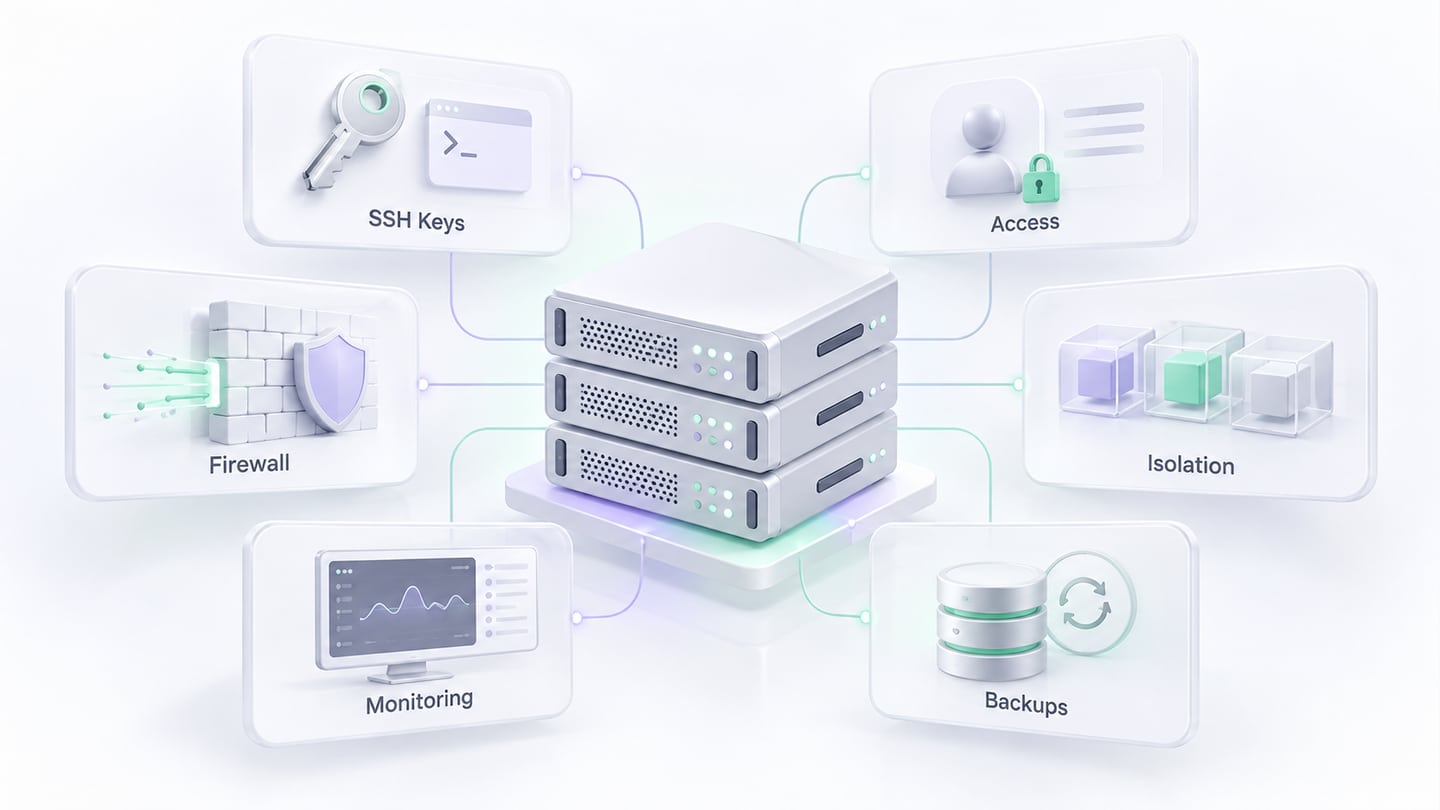
Infrastructure control becomes useful through administration. The following principles describe sensible operational priorities, not a checklist that certifies a particular server or a claim that every control is implemented identically across our environments.
SSH keys: Properly managed keys support strong administrator authentication without depending on a reusable login password. The private key still needs protection, access should be reviewed, and credentials that are no longer needed should be removed. A key is part of an access process, not permission to ignore it.
Restricted privileged access: Disabling direct root SSH login reduces unnecessary use of the most powerful account. Administrators can work through identifiable accounts and elevate privileges when needed. This makes the difference between everyday work and exceptional authority more deliberate.
Firewall rules: Network access should be limited to services the system actually needs to expose. A firewall does not repair vulnerable application code, but reducing unnecessary exposure is still valuable. Rules also need review as services are added, moved, or retired.
Least privilege and service isolation: Users and applications should receive only the permissions their work requires. Unrelated applications should not unnecessarily share sensitive execution privileges. The aim is to reduce how far a mistake or compromise in one component can reach, while keeping the system maintainable.
Software updates: Verified security updates need prompt attention, with compatibility and service checks appropriate to the environment. Knowing that an update exists is different from confirming that the relevant running software has received it. Ownership of that final step should be explicit.
Backups and recovery: Reliable backups, preferably encrypted, support recovery when prevention is not enough. Recovery planning matters as much as creating copies: the business needs to understand what can be restored, who can restore it, and how the process is checked. Backups do not replace patching.
Monitoring: System health, failures, and security-related events deserve ongoing attention. Monitoring helps a team notice problems and investigate them; it does not guarantee that every attack will be detected. Useful signals also need someone responsible for responding.
Infrastructure decisions are business decisions
The cost of infrastructure includes the time needed to maintain it and the consequences of uncertainty when something goes wrong. A flexible environment is valuable only when the organization can use that flexibility responsibly. For some businesses, the right answer is a well-managed shared plan. For others, managed services or a VPS better match the application and the team.
Our choice reflects the work we do: custom websites, business applications, and integrations that benefit from an environment we can adapt directly. The October PHP releases offered a concrete example of that value, without changing the original reasons for our decision.
The advantage of VPS hosting is not simply performance. It is the ability to control your infrastructure when that control matters most. Combined with maintenance, verification, and recovery planning, that control can support business continuity and leave room for the software a business will need next.